Imagine living in a community where electricity is considered luxury and no one even dares dream about it, portable water is not a topic of conversation, there’s no elementary school nearby, more than a thousand people using four public latrines whose walls are mostly smeared with excrements and floors dotted with faeces of all shapes, sizes and smell, households of five and above cramped in two rooms with zero soundproof and surviving on a little under USD80 per month as salary, a dirty two-room Aide Post with some paracetamols and a “nurse” who’s hardly had a GCE Ordinary Level Certificate and can barely administer an injection. Among other illnesses, we were so exposed to typhoid and malaria as kids that we either died as babies or our systems became immune to them and we grew up happily. That’s how bad it was growing up in Kompina Camp II over two decades ago.
In the midst of this abject poverty, political parties always made sure they showed up when they needed our parents’ votes, with lots of promises about how things would get better. Of course, our poor parents would believe them and cast their votes; and of course, things only got worse as these people would disappear into thin air only to reappear the next elections season, with the same promises.
Most often, these promises were accompanied with a glass of salt or rice in exchange for votes. As a result, our parents gradually lost focus on the whole point of choosing a competent leader as what a candidate had to offer them became more important than their manifesto. It was something along the lines of, “I’m selling my conscience. I’ll cast a vote for you if only you can buy it.” Don’t they deserve what they got?
But truth is, these people had simply lost faith in the system, accepted their fate, and decided that a bird at hand is worth two in the bush. I remember my father and his friends discussing after political rallies, saying politics is nothing but “scratch ma back I scratch ya back”, Pidgin for “Scratch my back and I’ll scratch yours”. To them, they’d only vote a candidate who could offer something in exchange. Also, our parents believed that elections were always rigged and there was no point killing oneself over voting one’s conscience, or voting at all.
Later, as I grew up, I realized the same trend nationwide – people whose lives were terribly impoverished due to bad policies were offered bread and sardine, soap, money, T-shirts, pens, groundnut oil, just to name a few, to vote the ruling party. Then it hit me – while the level of poverty and suffering differed from one place to another in the country, the general belief was almost the same: elections always get rigged by the regime in power; there’s no point voting at all if the vote will not count; while the ruling party is doing a poor job, no other party can come anywhere close to what it is already doing.
Guess what? Over the years, the ruling party has been using this to its advantage as it always encourages its militants to register massively and ends up winning. The people lost their power to effect change when they lost faith in themselves and eventually in the system. CPDM has been able to stay in power for 43 years thanks to the inaction of a disgruntled majority. Yes, your silence is a vote for the candidate you do not like. Whether elections are rigged or not, I can’t tell. However, how can you sit and complain that elections were rigged when you didn’t exercise your civic right to vote? Until we play our part, we can’t hold others responsible for not acting in a certain way.
It’s been over 50 years now that Cameroon got its independence. During this period, the country has known only two presidents: President Ahidjo from 1960 to 1982, and President Paul Biya from 1982 to date. President Paul Biya is now 92, has ruled the country for 43 years already, and is seeking another term in office. If he wins, he’ll rule the country for another seven years – which means he’ll rule till he’s 99.
Some Cameroonians think he’s the best leader Cameroon could ever ask for; others think he’s the worst thing that ever happened to the country. But the question is, do you have a voter’s card and will you go out there to cast your vote for what you believe in?
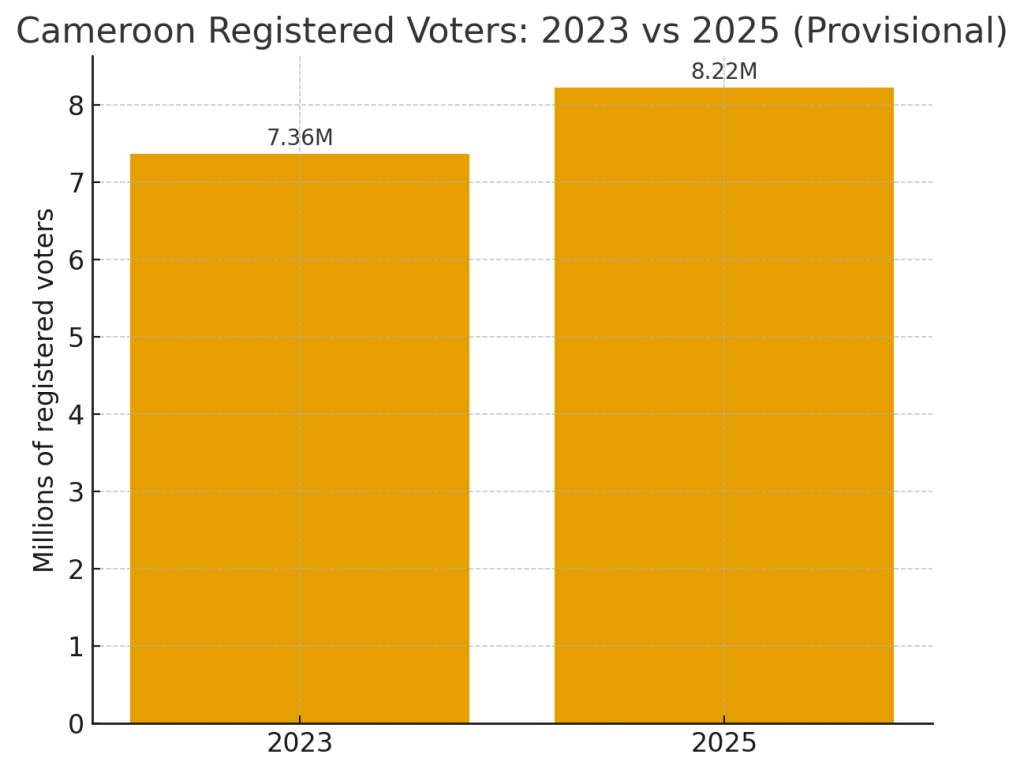
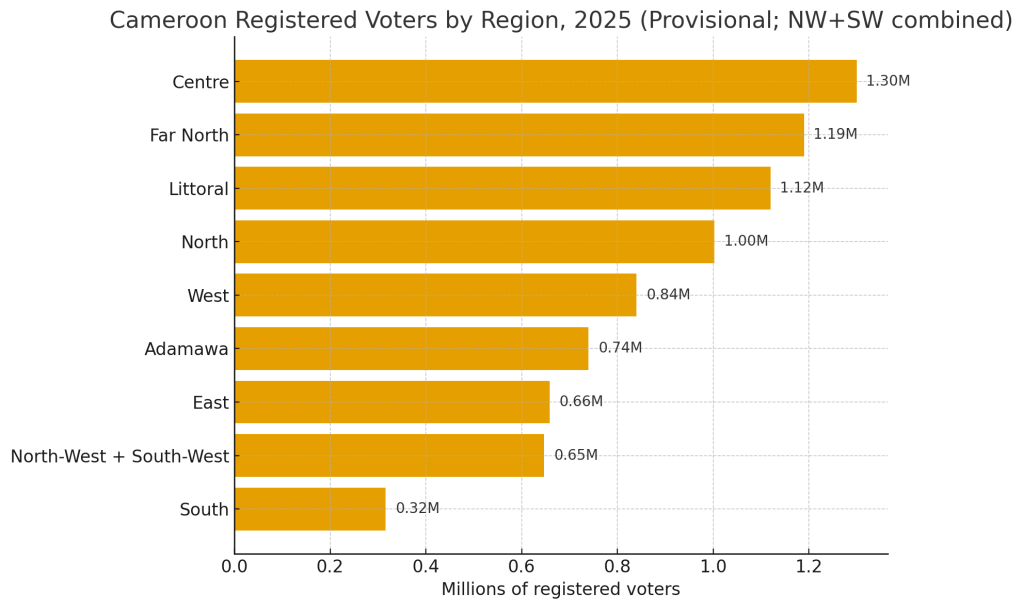
While the population of Cameroon currently stands at about 29 million, the electoral register ahead of the 2025 polls is 8.2 million, which marks a significant increase from 7.36 million voters in 2023, an 11.6% increase that should be applauded.
List of Candidates and Political Parties Taking Part in the 2025 Presidential Elections
This is a complete list of the candidates and their respective parties:
- ATEKI SETA CAXTON — Alliance Liberal Party (ALP)
- BELLO BOUBA MAIGARI — National Union for Democracy and Progress (NUDP)
- BIYA PAUL — Cameroon People’s Democratic Movement (CPDM)
- BOUGHA HAGBE JACQUES — Cameroon National Citizen Movement (CNCM)
- DZIPAN HILAIRE MARCAIRE — Progressist Movement (PM)
- ISSA TCHIROMA — Cameroon National Salvation Front (CNSF)
- IYODI HIRAM SAMUEL — Cameroonian Democrats Front (CDF)
- KWEMO PIERRE — Union of Socialist Movements (USM)
- LIBII LI NGUE NGUE CABRAL — Cameroon Party for National Reconciliation (CPNR)
- MATOMBA SERGE ESPOIR — United People for Social Renovation (UPSR)
- MUNA AKERE TABENG — UNIVERS
- OSIH JOSHUA NAMBANGI — Social Democratic Front (SDF)
- TOMAINO HERMINE PATRICIA epse NDAM NJOYA — Cameroon Democratic Union (CDU)
A few questions for you:
Did you register to vote, and is your name on the electoral list?
Have you listened to or read the manifestos of the various candidates?
Will you be going out to vote for who you believe can lead the country to a brighter future?
Or, will you be voting in exchange of a gift from a political party?
It’s your civic right to vote; it’s also your right not to. But do not forget, change begins with one vote, and then another, and then another. Your vote, as well as your silence, have the power to bring about change. While casting your vote is actively participating in bringing about the change you desire, silence is passively, and effectively, participating in bringing about undesired change. Whether or not you vote is up to you; whether or not you vote, you’re shaping your own future.
For those who’ve registered, see you at the polls on Sunday, October 2025.
Tubuo


 Tubuo Writes
Leave a reply to tubuoworld Cancel reply